|
November 17, 2024
Mites - Problem or Condition?
Mites identification, life, treatment
By: Michael A. Morack
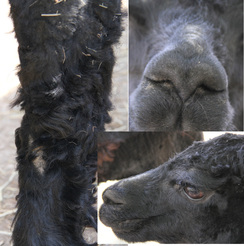
Symptoms include bare patchs or dander.
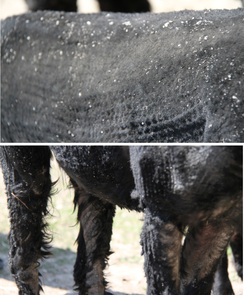
Advance - severity exposed thru shearing.
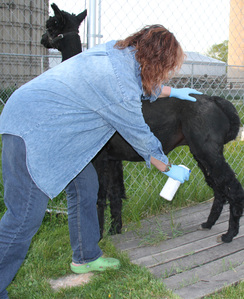
Application - rear legs.
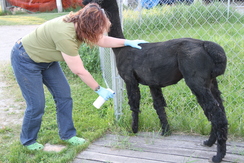
Application - Front Legs and toes.
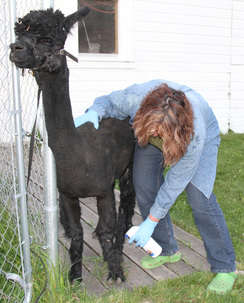
Application - rear of front legs.
Prior to this discussion getting fully underway we need to realize that there are many types of mites, four of which are most prevalent and each carrying there own level of severity of condition and treatment. Please understand, I am not an Acarologist (one who studies ticks and mites) but an Alpaca rancher who has encountered mites and done the research to understand the condition.
The four types of mites are divided into two groups; burrowing and surface. Burrowing mites are Sarcoptic and Demodectic. The surface mites are Chorioptic and Psoroptic. Type of mite identification is critical to successful treatment in that the type of mite defines treatment.
Sarcoptic mites are the most egregious and are the single mite that can transfer to humans causing a condition known as Scabies. Demodectic are most common in dogs and cats but are present in cattle, horses, and other livestock. Because these burrow, injection is the recommended treatment for alpacas. Dectomax had a better impact than Ivermec [1].
Psoroptic mites have been specifically associated with lesions around the ears and face [2].
Chorioptic mites or Chorioptic Bovis are the principal mites in this discussion. The standing treatment for this mite is the topical use of Fipronil (Frontline) due to the fact currently available ivermectin injectables and topicals do not work well in alpacas in that these mites do not burrow or draw blood. Pour on treatments fail because of the near absence of a lipid layer on the surface of the skin in alpacas that is used to translocate the medication over the entire body.[3]
What raised our awareness that we perhaps had mites was what I would refer to as a “general agitation” in our alpaca herd. What do I mean by “General Agitation”? At any one time we could observe an alpaca nipping its pastern, raising a leg and scratching a side, or rubbing the top of the head on the fence.
How do you identify mites? Our vet followed a procedure outlined by Drs. Ed and Ruthanne MaCaslin D.V.M. of Promised Land Alpacas in their article Mighty Mites: Chorioptic Skin Disease in Alpacas [4] and Llama and Alpaca Care, page 383,C2,P1. Take a #10 scalpel blade (blade only) and dull and dip in mineral oil to hold the mites. Choose a location on the alpaca. The location selected can express symptoms but we found the best location was between the toes. Scrape until capillary bleeding is observed to insure identification of Sarcoptic mites that may be present.
Tap the contents onto a slide. We started with 40x magnification under a microscope but Dr. Ed Macaslin stated 100x would be necessary to identify the type of mite. The pedicel structure is used to identify the type of mite. Chorioptic mite’s pedicel is short and unsegmented, the Sarcoptic mite’s pedicel is long and unsegmented, and the Psoroptic pedicel is long and segmented [Llama and Alpaca Care, page 385, C1,p1].
Following identification of a mite infestation we started observing patches of what best can be described as dandruff (flaking skin like fine sawdust), bare patches of skin especially on the inside of the legs and near armpits, and last as we parted fleece we would see skin suspended in the fleece looking like ice suspended above the water on cattails as the water levels drop.
Treatment for the Chorioptic mites was planned based upon a 70-day lifespan of the mite. Dr. Jon Gieche D.V.M. recommended treatment every 21 days for four treatments. The theory as applied removed the host through treatment to outlive the mite. Dr. Ruthanne MaCaslin stated, “They successfully eradicated mites from their herd twice with this procedure”. [Llama and Alpaca Care, page 385, C1-2,p2]
Along with the fipronil treatment we removed all chafe and bedding, washed walls, floor, ceiling, water buckets, feed troughs, internal fencing, tools, halters, and leads. The goal was reduction of the adult mite population providing greater impact of the fipronil treatment. [Llama and Alpaca Care, page 385, C2,p2].
Fipronil (Frontline) was purchased in 500 ml spray bottles anticipated to treat 10 alpacas. We found the number of alpacas 500ml treated varied based upon the size of the alpaca and extent we felt needed to be sprayed. Most alpacas were sprayed similar to spraying mosquito repellant from the knee down concentrating on the area between the toes. If bare areas on the nose or ears were observed, we applied fipronil to a gauze pad and wiped it on these areas. When we found the alpaca was further compromised we sprayed under the tail, between the legs, and the chest. [Llama and Alpaca Care, page 384-85, C2,p2].
We anticipated that a light mist spray would not upset the alpacas. Nothing could be further from the truth, so anticipate securing the alpaca fairly well before application. We found haltered and tethered to a wall hook, and then secure one side against a wall while spraying the facing side worked the best. Reverse the side to the wall for the rest of the application.
Dr. Jon Gieche and Dr. Ruthanne MaCaslin agreed the most probable place we encountered mites was at shows. Our investigation proved this is probably true due to the general responses we received. The general opinion was, “All alpacas have mites and are not a major problem. The only alpacas affected are due to stress, immune compromised, or a genetic predisposition.” Finding some veterinarians we talked to carry this same opinion, we feel owners come by this myth honestly.
Farms that have a substantial number of alpacas are at extreme financial risk due to the cost of treatment. Further, alpaca health is compromised due to mites. Mites will contribute to other problems such as bacterial and fungal infections. We do not feel other circumstances cause a mite problem due to the physiology of the mites themselves. Fleece degradation, cria development, and general animal health are at risk without treatment. Factor in our responsibility to bring healthy animals without infection issues to shows, and you have a couple of good reasons to treat alpacas for mites.
Prophylactic treatment is available once mites are eradicated from your farm. Prior to transportation, alpaca’s legs and underbelly should be sprayed with fipronil to eliminate mites that are present and introduction of mites to your farm. For arrivals to your farm, legs and belly should be sprayed with fipronil prior to departure and sprayed upon arrival before stepping out of the trailer.
Surviving a mild winter tempted us to believe this was causal to the mite outbreak; however, winter regardless of severity is the time mite populations generally explode.
If in fact all alpacas have mites we as a livestock industry face a serious problem. Marge, my wife, has been very sensitive toward publicly disclosing our mite problem fearing we shall be branded. My response regarding branding is not so much what we face as livestock owners but how we react to the problem and act once identified. We are treating our entire herd until mites are eradicated from our farm and have put in place stringent prophylactic practices. How we as individual alpaca ranchers react to this problem will define our livestock industry.
References
|