|
March 15, 2012
Strange Words on Wisconsin Farms
Learning venacular of the new Livestock in Wisconsin.
By: Michael A. Morack
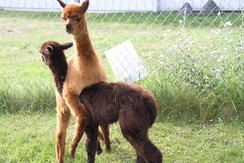
We do not produce two headed alpacas.
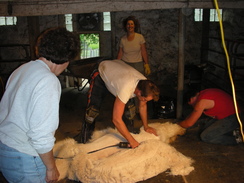
The production begins - Fleece harvest.
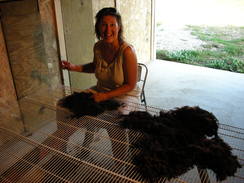
Preparation - Skirting the fleece.
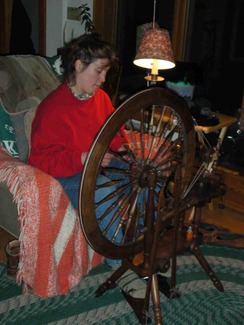
Product development - spinning fiber to yarn.
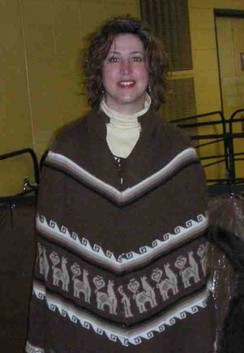
Final product - alpaca shawl and healthy living.
The Wisconsin farm started seeing strange terms such as cria, hembra, macho when referring to livestock. Add in a few others like Huacaya and Suri and you start to wonder are you on a Wisconsin Farm or a South American Estancia.
The rural landscape in Wisconsin is evolving perhaps seeing the reduction in the family dairy farm slowly replaced with what are now called factory farms where dairy cows are milked 24/7. That trend does not sit well with adjacent neighbors but to attain economies of scale is an economic reality – or is there an alternative?
Apparently there is but it comes with a Spanish lesson, perhaps more accurately a lesson in Incan history. Inca Royalty raised Alpacas (ah, another new term) for fiber and food for Inca Royalty over 6,000 years. The fabric was so superior that if you were not royalty and wore alpaca fabric it was a death sentence.
During the 1950’s, alpacas were nearly made extinct during an up swelling of socialism in South America. Herds were confiscated by the government and dispersed among the population at large. Controlled breeding herds were primarily turned to food. A few estancias anticipated what was coming and hid some key alpacas from dispersion such as Julio Berrada’s Accoyo between Macusani and Arequipa Peru. This managed to salvage some of the finer lines that carry forward to the alpacas we have today.
Larger numbers of alpaca were imported from Chile around 1980. Around 1993 a major effort was made by a few individuals to import alpacas into the United States from Bolivia, Chile, and Peru. This brought a bit of organization to the alpaca industry and the creation of the Alpaca Owners and Breeders organization and the Alpaca Registry Inc. We became aware of alpacas in Wisconsin in 1995, but by then there had been a fairly well established herd among several owners. In 2008 alpacas were recognized as livestock on the federal level and in Wisconsin in 2009.
Farm visitors started hearing about breeding hembras (female alpacas) to machos (male alpacas) to produce cria (newborn and young alpacas). Alpacas come in 26 recognized natural colors and that is something we can relate but then terms such as micron, SD, CV, and staple length might only be known on a sheep farm. The latter terms are used in describing scientific measurement of fleece.
Micron refers to the diameter or thickness of the individual fiber. The thinner the fiber, the thinner the yarn, the lighter and softer the fabric, the more comfortable and warm the garment. SD stands for Standard Deviation. OK, I am no math major either so basically it measures the diameter uniformity of the individual fibers. Again, uniform fibers spin to uniform yarn, and uniform yarn produces a softer feeling garment and reduces pilling (the characteristic of some fabric to create little balls of fiber on the garment). CV means Coefficient of Variation that is the micron divided by the SD. If we take a number of fleeces and put them all together in a bundle called a bale, this measures the consistency between the various fleeces and the consistency of that bale.
My favorite term refers to the alpaca production little discussed in polite company. You might say it is the backend production from alpacas. We use the term Beans. Imagine a field of jelly beans all one basic brown color and you have a good idea what beans look like. This is the waste of the alpaca. Alpacas are such efficient digesters of the organic matter (food) they consume that the solid waste has very little nutrient value for plants to grow. It does have one highly prized value to growers, humus that improves fertility, water retention, and friability.
Because alpaca manure is not considered “hot” manure, it can be applied directly to plants without composting, however, as with most manures washing harvested food before consumption becomes critical when used direct, so composting should be considered to cleanse the pathogens from the manure when used in vegetable gardens. Due to little or no odor, using alpaca manure on houseplants is very successful without composting.
You may have heard alpacas are a bit like cats and defecate in the same spot similar to cats. This in some degree is true so let me explain why I say somewhat. If an alpaca walks over to a spot and figures this is as good as any it will void. The next alpaca that comes along finds this same spot by smell and utilizes this same spot. This will become a preferred site for voiding.
Now that first creative alpaca decides that the place it originally choose is becoming crowed (I am not certain what criteria is used) will wander away and find a brand new location to void. As with the first location, when discovered by other alpacas in the herd they will then begin using this new spot. This is repeated over and over until it appears toilet distribution is everywhere.
The fact that they do choose a common area to void assists us in maintaining control on parasites. A clean pasture means a reduced parasite population in the pasture and reduced parasites in the herd. Therefore, cleaning is much easier due to proximity and the form of manure.
We have found that care of alpacas, handling alpacas, and providing a safe environment for alpacas is as easy as caring for our family dog so learn a little Spanish, a few terms, and visit the “new” Wisconsin livestock farm. If you don’t leave with a new appreciation of the livestock, you may leave with a higher appreciation of their products.
|