|
January 01, 2020
A Whole Lot of Educating Left to Do...
By: Lynn McClurg, Morning SKY Farm
 |
From shearing... |
 |
...to skirting... |
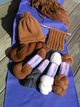 |
...to wonderful skeins and products! |
 |
Morning SKY Farm's own yarn |
I’m not someone who normally pipes up about controversial topics, but I’ve been getting a little frustrated lately by the number of people asking me about the alleged subsidies of alpacas and about all of the negative words regarding the topic of tax advantages. Someone even gave me a newspaper clipping. Why are they not asking me about the qualities of alpaca fiber? Have they ever worn any?
So bothered was I, that I pulled out the very well worn Random House Dictionary that I’ve had since college to see if I was misinterpreting the word “subsidy”. “A grant by a government to a private person or company to assist an enterprise deemed advantageous to the public.” “A grant or gift of money.” To my knowledge, alpaca breeders are not given monetary gifts, for, say, not breeding a particular year, and if agriculture related grants are available, they are made to breeders of other types of livestock as well. Tax advantages are granted to businesses of all kinds across the country, which help them to purchase equipment, etc. to assist their businesses to start up, to grow and to prosper. This is no different than in the alpaca industry, so why all of the fuss?
People create their conversations and form their opinions on a daily basis based on the limited amount of information that they have available to them or the limited topic that they wish to address. It seems that those taking the alpaca industry to task, were not aware that the numbers of alpacas have increased in this country over time because of something called breeding, a process necessary to creating the number of alpacas needed to obtain a quantity of fleece needed for a commercial level of alpaca fiber processing. They also must not be aware of the degree to which alpaca fiber in this country has been advanced over the years. All fiber colors have moved forward; black alpaca fiber has gone years ago from “Brillo” quality, as someone once said, to running close to or on par, in many cases, with white fiber. This is a result of the high degree of dedication by alpaca breeders to constantly analyze genetics, upgrade their herds, and to soak up information about alpaca health.
Alpaca breeders who may have utilized any normal tax advantages offered in order to advance their farm’s operation (as any taxpayer or businessperson would) can also be found in their farm offices, making breeding and business decisions, exhibiting their animals at shows, performing herd health tasks, and scooping beans on a daily basis to keep their farm clean and to prevent their alpacas from being at risk. If they don’t scoop or do herd health personally, they have created jobs by employing farm help or farm managers to assist them.
Cottage industries have been created as a result of the alpaca industry with the start of many mini-mills. Camelid veterinarians have been able to expand their customer base. More shearers have been employed to keep up with the growing number of alpacas needing to be shorn each year. Knitters and spinners have been given the opportunity to create additional products for income, with a fiber that has fabulous properties. American made alpaca products are available to the public through a variety of entrepreneurial sources in the US. Shouldn’t we be happy about all of these things?
Research is constantly being done on alpacas and their fiber, and ideas and potential applications are constantly coming to light. Items that we use and take for granted every day came about as a result of the space exploration program, which was and still is derided by some. In a research program, goats are being injected with genetic material from spiders that create a very strong web. Extraneous materials are then extracted from the goats’ milk, leaving a thin fiber that tested out to be stronger than steel or Kevlar; imagine the possibilities of that material. Patterns on sharks’ skin were found to prevent the build up of the barnacles on ships that impede the ships’ progress, and research is being done to apply those same patterns to items used in the health industry in order to prevent bacteria from lingering on things that we touch. Research is being done to determine if human health can benefit from the immune system of alpacas. With or without subsidies, these could each be “an enterprise deemed advantageous to the public “. Let’s redirect the public’s attention and the conversation to the place where it belongs - the qualities of alpacas and the potential of their fiber, and continue to educate those who may not fully understand our industry’s purpose.
Why did we choose to raise alpacas?
We bought some acreage.
You didn’t have to eat them.
Alpacas have luxurious fiber.
Ask me about it.
This article appeared in the Spring 2011 edition of PAOBA's official newsletter, The Planet, of which Lynn served as the coordinator.
|