|
October 28, 2025
Convention, Non-GMO, Organic...What's the Difference?
By: Buck Moon Farm
I've talked to many people who don't understand the difference between conventional, non-GMO and organic products. This won't be an exhaustive explanation, but I do want to give a few highlights of the main differences.
Conventional seed is the cheapest way to grow crops. There are federal government subsidies that help offset the cost of purchasing the seed, which is genetically modified in many cases (not all, depending on the crop) to work synergistically with conventional pesticides. An example of this is Roundup Ready® corn. GMOs are NOT the same as hybrid seeds, which have been around for generations. Hybrid crops are produced by crossing two different varieties of a crop to produce an offspring that has characteristics of both. This happens in nature and you can see it if you plant similar plants near each other. Cross pollination results in a hybrid result. The seed produced this way will not breed true in the next generation, so you need to buy new seed for each planting. Genetically modified organisms (GMO) seeds are the product of laboratory gene splicing, such as the Flavr Savr® tomato. These are trademarked crops due to the manual intervention in the creation of the end resulting seed. Roundup Ready corn® is a major crop and is used in conventional animal feed. Because it is cheaper to produce, it is cheaper to buy as animal feed.
Non-GMO feed is produced similarly to conventional feed, using similar synthetic chemicals for pesticides (a broad term that covers insecticides, fungicides and herbicides). The main difference is that the seed used is not genetically modified. This feed is slightly more expensive than conventional feed.
Organic feed is the most restrictive and therefore the most expensive feed produced. This is partly due to the lack of federal subsidies to offset the costs, and also to the elevated costs of certification and more labor intensive means of growing. The standards for organic produce and feed limit the allowable methods of production. All organic products are by definition non-GMO, but not all non-GMO products are organic. If you are wondering why organic produce, meats and dairy are so much more expensive, this is why.
Below is a chart outlining what is allowed in each standard. Hopefully this will help explain the difference in the three types of crops produced. The biggest thing you can do to help yourself stay healthy is to understand where your food comes from. Even organically produced seed oils and soy are still unhealthy. Being your own advocate for what you eat is one of the best things you can do for yourself and your family. Remember: you can pay your farmer or you can pay your doctor. Here's to your health! 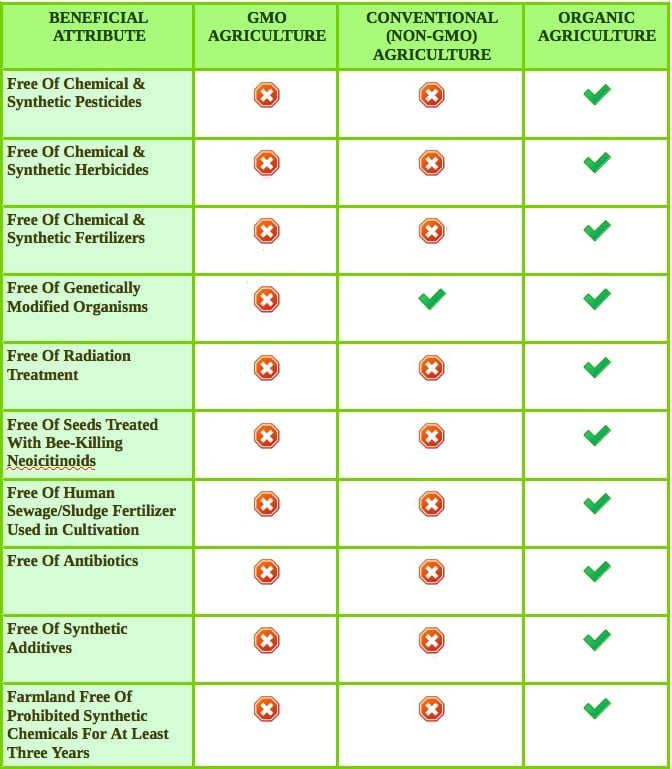
|