|
August 29, 2012
It's All About Prepotency
Evaluate to Excellence
By: Michael A. Morack
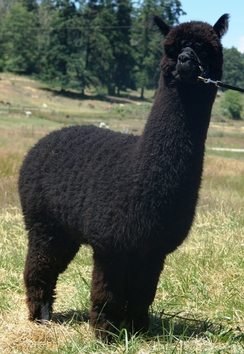
Mondavi - the father
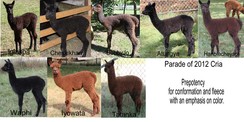
2012 cria through 8-26-2012
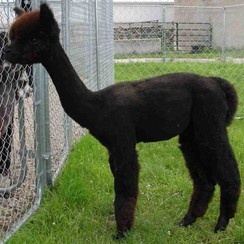
Mondavi's Raven Knight.
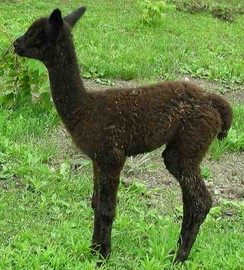
Mondavi's Iohitica.
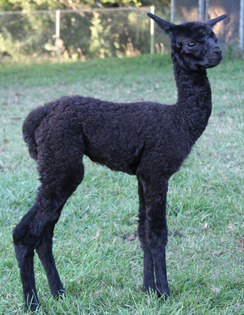
Mondavi's Heyun Sapa.
We need to agree on what prepotency is before we can entertain it as the single best tool to select an alpaca. Prepotency is an alpacas’ ability to pass on heritable phenotypic traits that it possesses without regard to environment or selected mate.
There are four evaluation criteria used for selection; pedigree, show results, phenotype, and progeny. Taken together, they are an adequate method to make a selection and use in a controlled breeding program.
Pedigree is research of an alpacas’ ancestry. The search criteria are identification of high impact alpacas. Taken by itself it resolves to a numbers game, seeking that alpaca that has generated more offspring than others as an indicator of selection for traits desirable by other owners.
Using pedigree has a number of flaws. First, was the alpaca utilized due to desirable traits, availability, good marketing, random selection, or perhaps an early part of a breeding program? Not knowing the owner, we do not have information what criteria the owner utilized for development. Was it the development of a line of alpacas, production, or simply an escaped male getting into the female corral?
Many alpacas were under the care of owners who had the marketing dollars and wherewithal to represent and expose their alpaca to the industry thereby providing many breeding opportunities. This would increase production but tells us little about the quality of the alpaca.
We can use pedigree in a different way. We can look at selection by consensus and how deeply the alpaca impacted the national herd. The first is understood – many owners selected that animal for breeding. What tells us perhaps this is an impact alpaca is seeing the first generation cria utilized. Taking this a step further perhaps we see a high percentage of a second-generation cria utilized and into third or forth generation.
There is one other gem we can pull researching pedigree and that is how the alpaca was used. Was the breeding repeated – the same dam and sire combination? Is there a high incidence of culling – gelded males as an example?
Show results certainly help an alpaca attain attention. It does not necessarily need to be a blue ribbon and banner, but certainly consistent performance in the show ring and many shows is a strong plus in that it is compared to many alpacas and hopefully some of the best in the national herd.
The shortcomings of a show assessment however are lack of time with the alpaca, the competition that given day, and experience of the judge. Judges place their hands on thousands of alpaca in a year and I would trust their trained ability to get it right most of the time based upon comparatives and that particular days environment. Lighting, temperature, and humidity can alter the perception and assessment on any given day and this can change hour by hour.
If the competition that particular day is not a top representation of the national herd, then comparisons will not be the top breeding stock of the national herd. Although the judge has the ability to deliver a lower placing to any alpaca that does not measure up, it is an assessment on that day.
Last, assuming that the alpaca is 2 years old that equates to over one million seconds in the alpaca life. Considering that the judge has all of 60 seconds to evaluate, compare, sort, and position that alpaca it leaves little to the imagination why owners often disagree with the judge’s evaluation. Last the show is a phenotypic evaluation only and at best gets attention for an alpaca.
Phenotype is the assessment of traits of the alpaca – conformation and fleece. This can be hands on evaluation or an assessment based upon measurable traits such as histograms, skin biopsy, or a photograph. A great deal can be learned about the qualities of this one alpaca but it is difficult to determine if those traits were a fluke or attributes that are highly heritable.
Histograms and skin biopsies are assessment tools that objectify the evaluation providing information about fleece characteristics. The results are comparable but some subjectivity is involved due to where the sample was pulled. The sample may not necessary expose an inconsistent fleece that has fine crimp in one area and not another. Then there is the testing method utilized. Are the tests comparable? What timeframe do they represent? How representative are the samples to the entire alpaca? What were the environmental conditions under which the fleece was grown?
As you can see, although the testing provides definitive information it must be taken with caution especially if this would be the only evaluation criteria. Phenotype, using measurable results has limits and the largest is it looks only at that alpacas traits. We cannot determine if those traits are heritable and if heritable exclusive to specific dams.
This now brings us to prepotency. To determine the prepotency of a particular alpaca requires the use of the prior three evaluation methods being used extensively on the offspring a particular alpaca produces and as many relatives that are available. Ideally we would like to see the progeny across as wide a range of alpacas to access the strength of traits passed along. This makes assessment of a male easier than a female due to the larger basis of evaluation.
Are the progeny of the first, second, or third generation utilized further in breeding programs? Do the offspring have consistent show records? Do the measurable phenotypic traits indicate the qualities you seek? Have you had the ability to hands on the progeny yourself? What is the depth and quantity of progeny you have available to assess? What was the quality of the mate and what improvement or deficiencies were observed? Are specific pedigree brought into the breeding?
Short of an established EPD system that takes many of these questions into consideration these are the tools available for evaluation and selection. When a specific alpaca has peaked your interest the steps to follow are pedigree assessment, show record investigation, tested phenotypic traits that should include a hands on assessment whenever possible, and last a through look at the mating and progeny with this specific alpaca. Combined they make a formidable evaluation method that helps reduce but not eliminate selection risk and is the basis behind our method called Evaluate to Excellence.
Evaluate to Excellence is a study of the prepotency through exhaustive review of the mate and as many of it’s relatives that can be evaluated followed by an exhaustive assessment of the progeny for pedigree, phenotype, and show performance. This information is then translated to an index to provide an objective selection and comparative methodology in an attempt to reduce what is commonly referred to as “barn blindness” or “the fuzzy factor”.
|