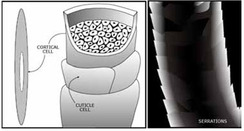
Fiber Composition
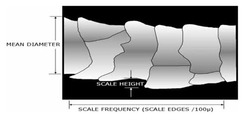
Scale Height
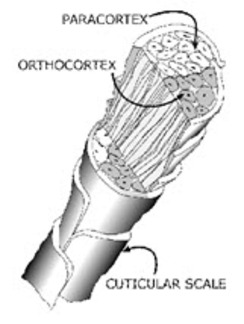
Internal Composition
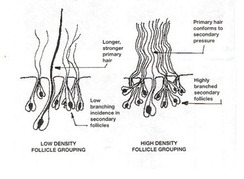
Primary vs Secondary Follicles
In order to make informed decisions on selecting quality foundation herd animals with desirable fiber characteristics, the new alpaca breeder must understand basic fiber anatomy and physiology. This section provides information that will help you understand the differences between suri and huacaya fiber what makes a good fiber producing alpaca.
Alpaca fiber is composed of three distinct elements; the cuticle or scale, the cortical cells and an intracellular binder to hold it all together. A complex protein called keratin forms the composition of the fiber. The fiber itself is a complex assembly made up of a vast number of cells. The inside of the fiber consists entirely of rounded elongated and spindle shaped cells called cortical cells. Cortical cells are thick in the middle and taper away to a point at each end. The outer cells (cuticle) are hard flattened scale-like cells which do not fit evenly together. The edges, of these cells protrude from the fiber shaft giving the fiber a serrated edge.
Cortical cells are the load-bearing elements of the fiber, whereas the cuticle imparts the inherent aesthetic qualities of the fiber such as softness of handle and luster. Other functions of the cuticle include water repellence, felting during washing, and resistance to chemical and physical attack. The entire assembly of cells is held together by a type of ‘cement’ called the intracellular binder.
Research has shown that the cuticle cells on sheep wool fiber protrude approximately 0.8 micron from the shaft whereas alpaca cuticle cells protrude approximately 0.4 micron. It would therefore be simple to conclude that the softness of alpaca over that of sheep wool of the same fiber diameter is due to the scale height (protrusion) .
Differences between Suri and Huacaya FiberThe first difference between huacaya and suri fiber is that cuticle cells of the Huacaya protrude slightly more than the Suri, Having less scale frequency and a lower cuticle height, the Suri fiber feels more slippery and is more lustrous than huacaya fiber.
The second difference between Huacaya and Suri fiber is in the internal composition of the fiber. The Huacaya has a bilateral structure similar to sheep and the Suri does not. Bilateral structure refers to the presence of the two types of cortical cells which are classified as either orthocortical cells or paracorticle cells. These cells grow in bundles next to each other. The bilateral formation is responsible for the crimp/crinkle in the Huacaya. The orthocortex bundling is always found on the outside of the crimp curve. As the two cortical cell types grow alongside of each other the orthocortex provides the tension that forms the curve of the crimp while the paracortex, under less tension, causes the crimp to stay in place. There is no visible line of distinction between the two cortical cell types in the suri fiber and thus the suri fiber is characterized by relatively straight fibers rather than crimp.
Because of different fiber structures, huacaya and suri require variations in processing techniques. Suri is generally more difficult to process. The machines are set at a lower speed than for the huacaya. Due to its cuticle cell structure and straightness Suri fiber lacks cohesion making it more difficult to ‘spin’ and there is slightly more fiber wastage when processing. Also, because of the straightness of the Suri fiber compared to the crinkle in the Huacaya, more fibers are required in a Suri yarn than that of a huacaya. This gives suri fiber more bulk and a heavier weight.
Follicle and Fiber TypesFollicles are the skin structures from which the fiber grows. Alpacas have two distinct follicle types: the primary follicles and the secondary follicles. Primary follicles are the first follicles to develop in the fetus during the first three months after conception and are the focal point around which secondary follicles form at a later stage. Primary follicles produce fibers that are greater in diameter and have little or no crimp in the staple and no crinkle in the individual fiber. These are the relic of guard hairs that are seen in primitive types of alpacas as long, straight hairs that project beyond the length of the finer and softer down underneath.
Secondary follicles produce the undercoat or down of the fleece and are the softer, finer fibers that give alpaca fiber its luxury feel and improved insulation qualities. The secondary follicles develop around the primary follicles after the fourth month to create follicle groups. A higher ratio of secondary follicles to primary follicles creates finer, softer and more uniform fleeces. In huacayas, the secondary fibers create the crimp which is exhibited as waves within the staple or lock.
A subtype of the secondary follicle is called a derived secondary follicle. Fibers from derived secondary follicles exit the skin from the secondary follicles they are grouped around. They have their own follicle root and enter the follicle sheath from the side and share a common exit point from the skin. These fibers are the finest the alpaca produces and form a higher percentage in the fleece of elite alpacas. The noticeable fineness may be due to the increase pressure of several of these fibers exiting the same skin opening. This causes the fibers to not only squeeze through by becoming finer but also longer because of the squeezing action. Needless to say, these are highly desirable fibers.
A third type of fiber is called medulated fiber. Medulated fibers are course fibers that cover a range of types including solid, hollow and various grades between the two extremes. They create problems for the fiber processors in that they do not accept dye readily or uniformly thus producing variations within the yarn that make it largely unacceptable for premium markets. They present customer acceptance problems for processors because they have sharp ends which protrude from the finished product and create a prickle factor when felt against the skin. In the early days of alpaca development in the U.S., much was made of the supposed superior insulation properties of this miracle fiber with its hollow core. Alpaca fiber was touted as having 5, 8 or even 10 times the insulating qualities of even the finest wool. This claim is without foundation and has been debunked for some years now but it is occasionally aired with conviction.
The Correlation between Density and Fineness
Density is defined as the number of follicles per unit area of skin. Density is a highly desirable trait not only because dense animals produce heavier fleeces, but their fiber will most likely be finer as well.
As fleece density increases the primary fiber diameter decreases due to the pressure of secondary follicles forces the primary to conform to the group average as they from tight, individual bundles of closely aligned fibers. Because of these closely aligned fibers, you can visually identify a dense fleece by the ability to clearly see all the way to the skin of the alpaca when parting the fleece. In fleeces that are not dense, the primary fibers may be as thick as 30 to 40 microns in a young animal and there will be more crossing and intertwining of fibers making it more difficult to see the skin.
Some alpaca breeders report an increase in fiber density after the first shearing. A possible explanation of this is that even though the derived secondary follicles are normally in place by birthing, the appearance of the fiber from these follicles may take some time after birth to become apparent. Shearing may stimulate the growth of fiber from the derived secondary follicles .
Fiber expert Cameron Holt from Australia describes the difference between primary and secondary fibers in the video interview:
If you like this article, please...