• Home
  • Animals Farms Products
  • Pricing
  • Websites
  • List your animals
    • Sign In
    • Sign up - Get started
    • Help & Support
    • Herd Management Website Hosting About Openherd

Search Animals for Sale

  • Alpacas (8299)
  • Goats (406)
  • Swine (10)
  • Yak (85)
  • Sheep (106)
  • Dogs (28)
  • Llamas (38)
  • Chickens (18)
  • Cattle (15)
  • Miniature Cattle (3)
  • Rabbits (29)
  • Horses (32)
  • Miniature Horses (15)
  • Ducks (5)
  • Donkeys (12)
  • Birds (3)
  • Geese (2)
  • Quail (1)

— The Openherd Team

Browser not Supported

Please update your browser to a current version of

  • Google Chrome
  • Mozilla Firefox
  • Microsoft Edge
  • Opera
Heritage Farm Suri Alpacas - Logo

Heritage Farm Suri Alpacas

Valuing the Past...Breeding for the Future

Share
  • Email a Link
  • Share on Facebook
  • Share on X
  • Pin on Pinterest
Save

2024 - 2025 Presenting Sponsor

 Photos
2024 SHIP Suri Simply Stunning Our Century-Old Barn 2023 Reserve Suri Breeder of the Year 2021 SHIP 2014 SHIP
Tim & Beth Sheets
4175 N. 1200 W
Flora, IN, 46929
765-860-1220
765-860-9872
ourheritagefarm.com
Send Message
YouTube
Facebook
X

Member of

Suri NetworkIndiana Alpaca AssociationKentucky Alpaca AssociationMOPACAPacific Northwest Alpaca Association
  • About
  • Animals
  • Products
  • Photos
  • Blog
  • Articles
  • More
    • Artisan Christmas Market
    • Farm Stay
    • Fall 4 Alpacas Open Farm Day
    • Ten Things You Never Knew
    • Shearing Day Open House
    • Social Media
    • Country Christmas Open House
    • Easy Dose Calculations
    • More Great Information
    • Alpaca Tip Sheets
    • Getting Started Guide
    • Event Calendar
    • The Importance of Suri Luster
    • What Are Accoyo Alpacas
    • Map to Heritage Farm
    • About Us
    • Getting Started Guide Sign up
    • Getting Started Guide Download
Book a farm event >
FarmArticlesFollicle and Fiber Types
Share
  • Email a Link
  • Share on Facebook
  • Share on X
  • Pin on Pinterest
Save
Heritage Farm Suri Alpacas - Logo
Alpacas31
  • Foundation
    • Suri11
  • Breeding Stock
    • Suri Females9
    • Suri Males12
  • Herdsires
    • Suri8
  • Jr.Herdsires
    • Suri3
  • For Sale
    • Suri Open Female5
    • Suri Male10
  • Sold1
Products16
  • Clothing & Apparel15
    • Footwear15
      • Socks15
  • Books & Media1
    • Farm & Herd1
      • Farm Planning1


Proud Member of

Suri NetworkIndiana Alpaca AssociationKentucky Alpaca AssociationMOPACAPacific Northwest Alpaca Association

Featured Items

Photo of HFS Picotani
HFS Picotani
White
2021 National Show Champion
$7500
Stud Fee: $1500

July 05, 2012

Follicle and Fiber Types


By: Tim Sheets
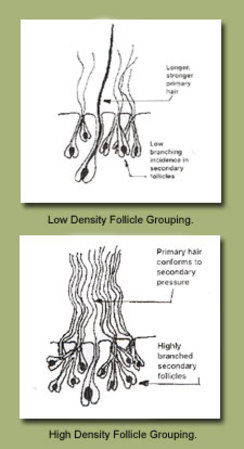
This article from our Getting Started Guide discusses the importance of follicles and the corellation to fiber fineness.

Follicles are the skin structures from which the fiber grows. Alpacas have two distinct follicle types: the primary follicles and the secondary follicles. Primary follicles are the first follicles to develop in the fetus during the first three months after conception and are the focal point around which secondary follicles form at a later stage. Primary follicles produce fibers that are greater in diameter and have little or no crimp in the staple and no crinkle in the individual fiber. These are the relic of guard hairs that are seen in primitive types of alpacas as long, straight hairs that project beyond the length of the finer and softer down underneath.

Secondary follicles produce the undercoat or down of the fleece and are the softer, finer fibers that give alpaca fiber its luxury feel and improved insulation qualities. The secondary follicles develop around the primary follicles after the fourth month to create follicle groups. A higher ratio of secondary follicles to primary follicles creates finer, softer and more uniform fleeces. In huacayas, the secondary fibers create the crimp which is exhibited as waves within the staple or lock.

A subtype of the secondary follicle is called a derived secondary follicle. Fibers from derived secondary follicles exit the skin from the secondary follicles they are grouped around. They have their own follicle root and enter the follicle sheath from the side and share a common exit point from the skin. These fibers are the finest the alpaca produces and form a higher percentage in the fleece of elite alpacas. The noticeable fineness may be due to the increase pressure of several of these fibers exiting the same skin opening. This causes the fibers to not only squeeze through by becoming finer but also longer because of the squeezing action. Needless to say, these are highly desirable fibers.

A third type of fiber is called medulated fiber. Medulated fibers are course fibers that cover a range of types including solid, hollow and various grades between the two extremes. They create problems for the fiber processors in that they do not accept dye readily or uniformly thus producing variations within the yarn that make it largely unacceptable for premium markets. They present customer acceptance problems for processors because they have sharp ends which protrude from the finished product and create a prickle factor when felt against the skin. In the early days of alpaca development in the U.S., much was made of the supposed superior insulation properties of this miracle fiber with its hollow core. Alpaca fiber was touted as having 5, 8 or even 10 times the insulating qualities of even the finest wool. It is now generally thought that this claim is without merit. Hollow, medulated fibers are not desirable.

Australian fiber expert Cameron Holt describes the difference between primary and secondary follicles in this video:

© 2026 Openherd Terms Privacy
More info
List your animals

Openherd

We exist to help family farms be successful.

  • About Openherd
  • Herd Management
  • Marketplace
  • Websites
  • Terms & Conditions
  • Privacy Policy
  • Facebook page

Support

100% U.S.-based email and phone support!

  • Support & FAQ
  • Join Openherd
  • Plans & Pricing

Advertise

Advertising for farms, vendors, professionals, and corporate.

  • Advertise on Openherd
  • Advertising types, costs
  • Create an ad (account required)

How Openherd Works

Our system is easy, affordable, and effective:

  • Livestock Marketplace
  • Herd management
  • Farm website hosting
  • All managed in one place!
  • Learn more List your animals!

Website Hosting

The easiest farm website you'll ever have!

  • Websites
  • Website Designs
  • Domains, SSLs, Email
  • Ecommerce
  • Concierge Services
  • How to create your website
  • Why Openherd websites are best for farms