|
June 11, 2013
Common Sense Color Inheritance
Attempting to Explain Color Annomalies
By: Michael A. Morack
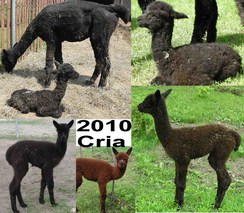
Black production from Black
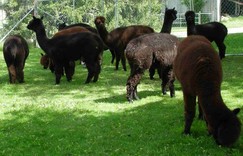
Dominate Black
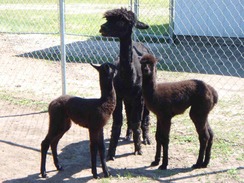
Cria from black dams
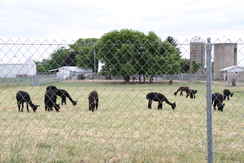
Black herd produces black
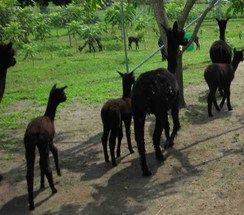
A long line of black alpacas
Gregor Johann Mendel discovered and refined the theory of inheritance in 1865 and did not become the core of inheritance theory until included in Thomas Hunt Morgan’s Chromosome Theory of Inheritance 1915. Mendel’s discovery predicted trait expression based upon mathematical probabilities.
OK enough history and definitely enough math both of which I was never very adapt but they are important if we are to approach color inheritance in alpacas and attempt to understand some of the anomalies.
This discussion is based upon observation more than practical science and might end up being more interesting reading than fact. Alpacas have been domesticated and bred through selective breeding for over 5,000 years in South America. During this time 26 distinct colors developed making it a prized fiber for fabric before the introduction of dyes for artificial fabric colorization. A real boon when most fabric was brown.
Brown was not a selective breeding trait but a trait selected by nature. Brown provided an ability to hide in foliage, desert scruff, and just about every type of environment in existence. Nature selected pattern in some to minimize attention in a world filled with predators. It was the predator that first introduced selective breeding methods by selecting its next meal based upon the animal that stood out from the herd.
Our common sense approach to color inheritance places brown as the dominant color trait in alpacas. By example the Vicuna and Guanaco both show a preference to this color. When humans interjected themselves into color inheritance through controlled and selective breeding methods gaining attention became a dominant trait selector for survival. If a person could develop a fabric that was not brown their status in the tribe was enhanced and might even gain favor among the aristocracy.
We can see this development in the way royal alpaca fiber was treated among the Inca. Certain alpaca fiber was only to be worn by the ruling aristocracy and to break this mandate meant death.
Our theory will rely upon this human trait to lend credence to developing and selecting color variation in alpacas. With the advent of dyes fiber now needed a second purpose – how well can the fiber accept coloration? How consistently can the fiber be colored reducing variation in the final fabric? Dying fiber placed specific pressure on certain color choices.
Religion also played a role in color selection. Black alpaca fiber was revered as supernatural and linked to the gods. Black fibered alpacas were refined as the ultimate sacrifice to gain favor from the gods by the Incas. I will go out on a limb and speculate it was possibly tied to the underground where connection to the gods was thought to exist but I have no empirical basis for this other than it seems to make sense. We will get back to this a bit later.
Unnatural colorization put pressure on breeding choices and that pressure was the development of white in alpacas. This was not a color selected by nature and its occurrence in the wild usually was selected for dinner by nature. We can surmise that because this color in nature was rare that it represents a recessive trait. Incidence was so rare that special selection was required and even then only 25% would be successful.
How is it that today white appears to be the or a dominate color in alpacas? My common sense approach to this question looks at practice in the breeding selection. When white is selected at a higher and higher frequency it produces a high number of alpacas with the white recessive trait. The result of that selection process becomes so dominate that a recessive trait becomes the great deceiver and takes on the characteristics of the dominate trait producing a population of all white recessive.
If we can accept the premise that human selection has supplanted natural selection and defined dominate traits as both dominate and combined recessive then we start to see how over 5,000 years humans could develop an alpaca herd with 26 distinct colors.
We see our postulation for white carried into black, gray, or fawn with brown being the most common color trait that shows up when breeding similar colors. Probably the most demanding color selection to breed is gray whether it be silver or rose gray. Our thoughts regarding this challenge is that it is an emerging color choice and human selection chose to blend color to obtain gray rather than breed for the color gray. That would make gray a recessive trait with few animals in possession of the trait and providing an outcome in gray only 25% of the time in a pairing.
Black is another color that had selection pressure due to human idiosyncrasies. Because of its similarities to the underground (absence of light), it became associated with some Incan deities and became a selection for ritual practices. Again, forcing a recessive trait to the forefront so that it behaves much like a dominant trait.
Here we are in the 21st century and color selection has demands from many practices. It will be interesting to see what color inheritance does in the next 100 years driven by the fabric industries and fashion world perceptions.
|