|
April 13, 2023
EPDs? Should You Use Them?
or Maybe A Meat Production Trait Should Be Included?
By: John Heise
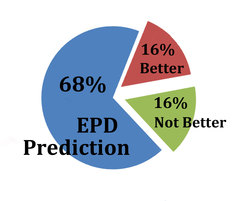
EPD PREDICTION RESULTS

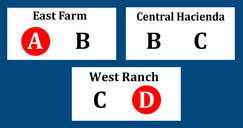
CONNECTEDNESS
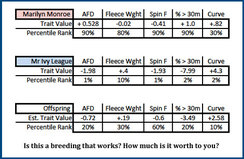
Estimated EPD of Marilyn Monroe Offspring
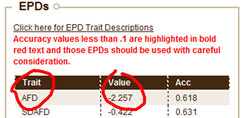
AFD Trait Value
People raise alpacas for many valid and useful reasons. However, breeding alpacas and producing offspring should be linked to a purpose. Alpacas are mostly a fiber producing animal but they can also do provide edible protein. Which direction does you breeding program focus on? If its neither, then it should be expected that by default, offspring are likely destined for the meat market.
Improving fiber quality to reach sustainability is not hard or expensive. However, understanding the AOA - EPD program can be confusing. It is unfortunate that much of the “discussion” to date has been filled with misunderstandings and misinformation and has taken the focus off the reality of the usefulness of EPD’s.
It may be of help to start with a definition of what EPDs are. This is Wikipedia’s definition of Expected Progeny Difference. “EPD are an evaluation of an animal’s genetic worth as a parent. They are based on animal models which combine all information known about an individual and its relatives to create a genetic profile of the animal’s merits. These profiles are then compared only to other individuals of the same breed.”1 For me, this definition is perfect because in this article I am trying to tackle the “animal’s merits” and comparing them to others.
I frequently hear that EPD trait vales are confusing when "Fluffy’s" first histogram comes in at an AFD of 18 microns but her EPD trait value for AFD is a “plus one” which predicts that Fluffy’s genetics for AFD is stronger or coarser than the average of the whole EPD group. Keep in mind EPDs predict the genetic package that it will contribute to its offspring in a breeding. That prediction is based upon ancestry and production. It is also a prediction of that offspring's lifetime production as compared to all the animals that are participating in the program. Where as histograms describe phenotype of that animals' production at one point in time.
An EPD prediction will be true or better than predicted 84% of the time. EPD predictions will be less, or "poorer" 16% of the time. There are no games in Las Vegas that provide those odds.
How EPDs are calculated is complicated. That’s what computers are for. So, here is my simple summary. EPDs are calculated using a statistical science called BLUP. It is the same science that we’ve seen on TV where the investigators can clear up a noisy recording and end up with a clear voice or sound. BLUP tries to resolve what is related and what is not relevant. I don’t need to know how they do that. I’ve seen it catch criminals on TV, that’s enough for me. If you need more information Wikipedia and Google have articles and links to click on till your heart is content.
But that is only part of the story. What really makes EPDs even more useful is the ability to compare animals being raised in different locations of the country, under different environments that are of different ages.. So how is that done? EPD's also uses a science called Connectedness. The program looks for a path to connect all the animals in the program and make a prediction based upon what it has learned. I have included a simple visualization of what connectedness is. (Connectedness Graphic) East Farm has animals from A & B bloodlines. Central Hacienda has animals from B & C bloodlines and West Ranch has animals out of the C & D lines. It isn’t difficult to grasp that science could evaluate environment differences in the farms that share common ancestry like East Farm and Central Hacienda share B bloodline genetics. But connectedness can also determine connections from perceived disconnected parts like A and D through their environment connections with B & C. Obviously this is a very big simplification of very complicated process. But basically it is important to correctly identify true "Cohort Groups" which are animals that are all raised under the same conditions. The AOA data collection process provides the ability to input data for animals that are cared for at different locations. There is a link below if you would like to learn more about Connectedness 2.
An EPD prediction provides a number ... a value for each trait, called a Trait Value. That Trait Value provides a placement or rank of how that animal fits in the overall picture for that specific trait. When looking to improve fineness you want to reduce AFD. A smaller or negative number is desired. When wanting to increase fleece production a larger or positive number is desired for Fleece Weight. To help simplify comparing individual numbers each trait value is also "Ranked". Ranking provides a quick visual on where an animal fits in according to the whole population and will help simplify your research for breeding and purchase decisions. Utilizing ranking also very helpful in avoiding the issues involved in single trait breeding. Traits such as AFD and Fleece Weight have a contradictory or antagonistic relationship to each other as does Curve(crimp) and Staple length. Using the full EPD profile makes it possible to make selections based upon overall trait improvement. Ranking facilitates the selection process of several traits at once when looking through a large subject group .
EPD's are used for breeding match-up or pairing selection. The production quality of the offspring is estimated by averaging the trait values of the Sire and Dam. This process helps with identifying which pairing will help make the most genetic progress in your herd. I have an example for you to view in the Marilyn Monroe graphic. As you can see from the ranking of the offspring, this alpaca could be one generation away from elite offspring production. EPDs provide the most accurate and quickest method for herd improvement. .
Not everything that goes into a successful breeding operation can be identified and solved using EPD's There are other factors that also come into play when making breeding decisions. For example, you might have a preference for a certain color. There are also tools available to help with that as well. The art of successful breeding is determining the importance of each tool in your toolbox. It's expected that many more advances will be available such as DNA Enhanced EPDs (Genomic EPD's) for very quick and high accuracies in the future. I believe EPDs are the best thing to happen to alpacas to help the industry to achieve sustainability. I believe EPDs will provide the most predictable method to help bring alpacas back to the prominence they should have held in the world of natural fibers over the last 500 years.
References
|