Saturday, January 24, 2015
Fleece or Be Fleeced -- Part Two: Cria Fleeces
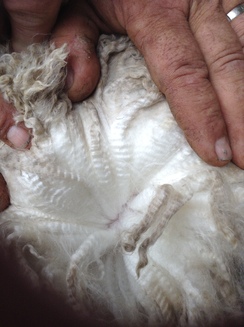
A gentle snow is falling here, and all the tree lines, fence lines, barn roofs are featuring softened edges. Postcard images of New England in winter are the order of the day here. So, I am at my computer and musing about fleeces, once again.
As someone that has focused primarily on production of elite whites and lights over more than seventeen years in alpaca breeding, I think it is time to discuss the wide range of “first fleeces” on crias, as these come in a wide array of styles that bear mention. Fleece improvement throughout the range of natural colors, too, will mean that what those of us with light herds are very accustomed to seeing will also be more prevalent across that spectrum of color with time. It is difficult to explain to the newcomer to alpacas that, after waiting nearly a year for that cria to arrive, they might have to wait for the second fleece before they have anything to crow about, but that can be the case many times. While I am the first to admit that patience is not my strong suit, I urge new breeders to cultivate some patience in the fleece department, as they will need it.
They Have It All: This is the kind of fleece that you almost pinch yourself and probably part daily, just to assure yourself that ‘they still have it.’ Everywhere you part this fleece, it exhibits all the qualities, from uniformity (of micron, of crimp style, and so on). Part on the belly, and it’s there, go up the neck, down the leg to the fetlock – good grief. If you shear such an animal down as a cria, expect a newcomer to the industry to say it looks like that animal has a chenille fleece when the regrowth appears. This is truly the good stuff. These cria tend to do well even when shown as juvies.
Well, This Has It All, But Why Does It Look Like a Suri and I Am Just Not Sure It’s Dense: Brightness bordering on luster, pencil-like staples that tend to hang down in tight tiny fashion. Watch this animal! You may decide that, over the years, this is THE fleece you love most in your barn. First of all, it is displaying an architecture that, with time, may give way to a They Have It All fleece, or it may stay as it is. I have to admit, I get these fleeces as first fleeces a great deal, but they tend to morph into They Have It All fleeces on the second fleece. Some people are more fortunate and see this fleece for multiple shearings. We usually feel an almost greasy hand to a fleece like this, as opposed to a “cottony” hand, giving us the feeling that maybe the sebaceous glands are more prevalent in this fleece. We also talk about a lower scale that causes the extreme brightness. Some dare call these SILKY. So far, despite fiber testing, we have not found a means of distinguishing these from the “They Have It All” fleeces in terms of an actual test. However, if you process a fleece like this by hand, you will note that it does process – just like silk, and it has very little static associated with having been processed, regardless of the low micron of the fiber. Now, in some cases, animals with these sorts of first fleeces do well in both halter and fleece shows, but not all do.
Well, I Swear He/She Had It, But He/She Seems to Have Lost It: When a cria sports this fleece style as a newborn, this one excites you just as much as the ones that have it all. But extremely fine cria fleeces do not always retain that initial corkscrew-like appeal and may grow out into what some of us call the “cria flats,” which is to say the fleece goes quite straight. Fear not, as messenger angels tend to say. Instead, look at the staples and note if they have a great deal of independence, or absence of cross-fibering. Are there whisper-width “tufties” protruding across the blanket? Some of these young animals actually do redevelop crimp from skin to tip with time prior to the first full shearing. Some won’t at all, but oh, wait until that second fleece grows in, as it will take on far greater eye appeal! Taking such an animal to a show in its first fleece can be a disappointment, but if you wait until they are yearlings, people will ask you why they have never seen this animal before.
I Just Don’t See Anything In That Fleece: Whether or not you shear it down when this animal is a cria or whether you simply leave it be, you just don’t see any crimp, but you do see almost a suri-like pencil quality to each staple and they are quite tiny and tend to hang down, as a suri might, albeit in a slightly more fluffy fashion. Those with this style, even shorn down, appear to have a very slight wave usually but brightness that really borders on luster. Here again, this is one of those “second fleece phenom” varieties. Give them time, and if you don’t believe me, ask anyone that has opted to sell a male with this fleece as a fiber animal while it is less than a year old.
Now, there are fleeces that, regardless of the care you take in matching the fine qualities of your “stud females” to a fabulous male that can support all that female’s great qualities and improve on that aspect you think needs a tweaking, the resulting offspring just may not be as great as you expect. In fact, beware of anyone that tells you that he/she never produces pet quality animals in his/her breeding program! This less than satisfying result can be due to almost anything, from the pure vagaries of livestock breeding to fetal development issues when the cria is developing the number of follicles. Moreover, sometimes a truly phenomenal dam with excellent qualities can be a “one percent of the Bell Curve” result and, regardless of the qualities of the stud to which she is bred, may never recreate herself, much less produce an improved offspring. You have done the very best that you can, and you won’t be the first to have this happen.