The Valais Blacknose Breed-Up Program
The Valais Blacknose Breed-Up Program is a long-term breeding initiative that requires dedication, patience, planning, and a strong understanding of genetics. Because purebred Valais Blacknose sheep were not originally established in the United States, breeders have worked carefully through structured breeding programs to preserve the characteristics and standards of the breed while building strong bloodlines domestically.
At Valais at Squibb Ranch, LLC, our program began with three purebred Scottish Blackface ewes selected for their strong maternal traits, hardiness, and structural quality. These foundation ewes became the starting point for our journey into the Valais Blacknose breed.
To establish high-quality genetics, we imported frozen semen from Swiss Maximum Points Genetic Rams sourced from respected farms in Scotland and New Zealand. These genetics were carefully selected to help maintain the traditional Valais Blacknose phenotype and preserve important breed characteristics.
Because Laproscopic Artificial Insemination (LAI) plays such a critical role in the breed-up process, we work closely with a Reproductive Specialist DVM experienced in ovine fertility and advanced sheep reproduction techniques.
For breeders considering starting their own program, we strongly recommend locating a qualified reproductive specialist familiar with sheep fertility, synchronization protocols, semen handling, and LAI procedures.
Understanding the Breed-Up Process
The breed-up program follows a structured generational progression designed to gradually increase the percentage of Valais Blacknose genetics while maintaining desirable breed traits.
A breeder may begin with a grade (0%) Foundation Ewe from an established breed such as:
- Scottish Blackface
- Hampshire
- PolyPay
- Horned Dorset
- Other approved foundation breeds
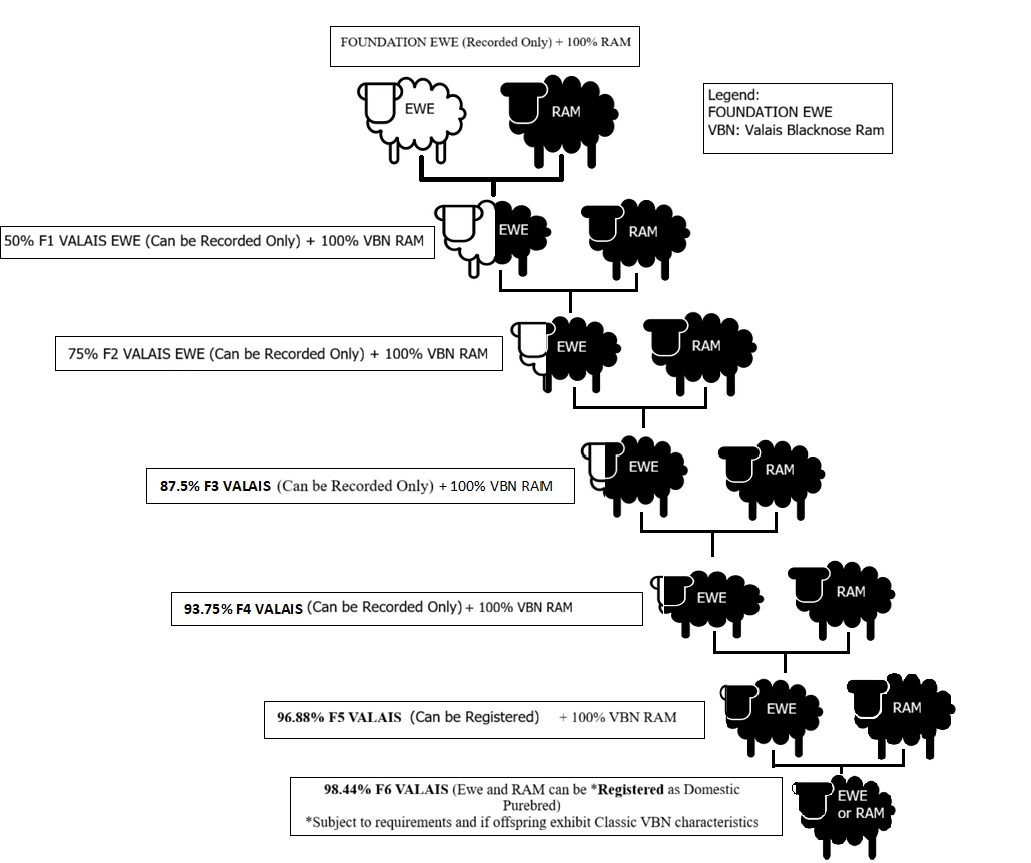
When a foundation ewe is bred to a 100% Purebred Valais Blacknose Ram, the resulting lamb will be considered:
- First generation (F1)
- 50% Valais Blacknose
Breeding progression then continues as follows:
- F1 crossed back to a purebred Valais Blacknose Ram = 75% Valais Blacknose (F2)
- F2 crossed back to a purebred Valais Blacknose Ram = 87.5% Valais Blacknose (F3)
- F3 crossed back to a purebred Valais Blacknose Ram = 93.75% Valais Blacknose (F4)
- F4 crossed back to a purebred Valais Blacknose Ram = 96.88% Valais Blacknose (F5)
- F5 crossed back to a purebred Valais Blacknose Ram = 98.44% Valais Blacknose (F6)
At the fifth generation, the ewe may become eligible for registration as a Domestic-Purebred Valais Blacknose sheep, provided she also meets the phenotype standards established by the Swiss Registry.
After approximately five generations—which often takes five years or more—a ram may qualify for Domestic-Purebred registration if the animal demonstrates the required phenotype, structure, wool quality, markings, and breed characteristics.
Why Phenotype Matters
Genetics alone do not determine whether a sheep qualifies for registration.
The Valais Blacknose breed is heavily evaluated on phenotype, meaning the visible physical traits and characteristics expressed by the sheep.
Swiss breed standards evaluate:
- Facial markings
- Leg markings
- Wool quality and curl
- Horn structure
- Body conformation
- Overall balance and appearance
- Breed character and expression
Even sheep with high percentages of Valais Blacknose genetics may not qualify for registration if they do not meet the required visual standards.
This is one reason why selective breeding decisions are extremely important throughout the breed-up process.
The Importance of Using Purebred Rams
To properly advance within the breed-up program, breeders must consistently use a 100% Purebred or Fullblood Valais Blacknose Ram.
Using lower-generation “clean-up rams” or F-series rams does not advance offspring to the next generation.
For example:
- An F2 ewe bred to an F3 ram will still only produce offspring considered F2.
This is because the progression system requires continual backcrossing to a purebred Valais Blacknose ram.
Using lower-generation rams may also create inconsistencies in phenotype expression, wool quality, markings, and structural traits.
For breeders focused on maintaining strong breed standards and predictable outcomes, consistent use of high-quality purebred genetics is essential.
Challenges Within the Breed-Up Program
The breed-up process can be incredibly rewarding, but it also comes with challenges.
Not every lamb born will meet breeding goals or qualify to continue within the program.
For example, ram lambs produced through lower-generation crosses often need to be castrated because they do not qualify for breeding advancement within the structured breed-up system.
Breeders must also carefully evaluate:
- Structural correctness
- Wool consistency
- Temperament
- Breed markings
- Growth and health
- Reproductive quality
Successful programs require long-term planning and a willingness to make careful selection decisions generation after generation.
Preserving the Future of the Breed
The goal of the breed-up program is not simply to increase percentages on paper. The true purpose is to preserve the beauty, consistency, health, and traditional characteristics of the Valais Blacknose sheep while responsibly expanding the breed.
At Valais at Squibb Ranch, LLC, we remain committed to ethical breeding practices, proper animal care, strong genetic selection, and preserving the integrity of the Valais Blacknose breed for future generations.
Every generation represents years of planning, investment, education, and dedication.
We are proud to be part of the continuing growth and preservation of this remarkable breed.
— Valais at Squibb Ranch, LLC
I hope this clears up any confusion.
If you are a visual learner, here is a fun chart to explain the process
United States Associations


International Associations