|
April 06, 2013
EPDs
THEY'RE HEEERE
By: SHEILA SCROGGINS
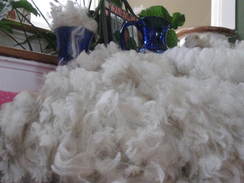
APPEARANCE IS ONLY SKIN DEEP
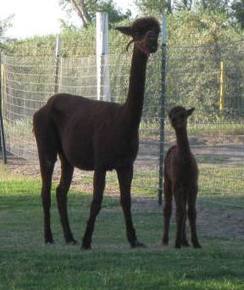
Heritability traits determines EPDs
Science Creates Beauty
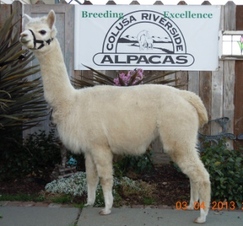
Genetic fineness is linken to animal size.
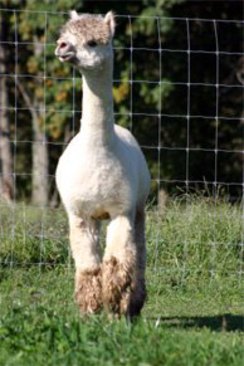
Meet Bogie; superiority in EPDs
Don't be left behind, the industry is rapidly changing.
An EPD is an Expected Progeny Difference (EPD). It has been my experience that when you ask an alpaca breeder if their alpacas have been EPD tested and what are their herdsire’s values, I usually get a look of utter astonishment. They have of course, heard of EPDs, but seem to be confounded by the thought that someone might ask. I doubt if a person was shopping for a bovine stud they would get the same response from a breeder.
Alpaca Registry, Inc., (ARI) and Ideal Alpaca Community (IAC) have recently joined together for the good of the alpaca industry and will have one registry for EPD determination and dissemination. As a new owner and breeder, I was looking for a means to gauge and guide my breeding. We knew we were starting out with improved and unimproved stock and what would get us to a better herd quickly. I learned early it was EPDs. Our business breeding practices became predicated on EPDs, so the news of this merger was good news for us.
As a Nurse Practitioner all choices for diagnosis and treatment of disease is driven by what we call the gold standard. This kind of decision making tool is not unique to medicine. The gold standard provides the practitioner with a means to an end that is tried and tested. The gold standard is the diagnostic that gives you the most information, the most reliability of information, at the least cost. Just like in medicine, the gold standard in all livestock breeding is the Expected Progeny Difference.
“EPD is a measure of the expected differences in performance of a sire’s progeny when compared to the average progeny of all sires evaluated within the same breed. This prediction is based on actual performance, progeny performance and relatives’ performance. (1) The bovine industry has somewhere around 18 EPDs for cattle. They have EPDs on such things as meat marbling with fat, carcass weight, and dam pelvis diameter. I include this information for you to see just how much breed information is possible with EPD calculations and ultimately EPD determination for a given species. It also tells us that it is possible to change or develop new EPDs as long as they are heritable traits.
EPD’s are nothing new. They have been around in other livestock species since the 1970s. I believe that in order to understand EPDs in the alpaca industry we should look to the bovine industry. The bovine industry has a long history of tried and tested practice with EPDs. The EPD processes between the two industries are identical, only the animal traits vary. This allows us to look at Bovine EPDs and extrapolate their years of usage to the Alpaca. The goal of an EPD for any industry is to determine the likelihood of a desired trait or conversely the likelihood of an undesirable trait in the offspring of either a male or female we are choosing to breed. In other words it is a statistic gamble where your expectations are significantly statistically higher with one breeding animal over another.
EPD’s for female alpacas are as relevant as those for males. However, a female will be bred approximately 1 to 12 times in a lifespan, but a herdsire can be bred hundreds of times. His contribution to the genetic pool is much greater than that of the female simply because of his numbers of progeny compared to a female. Hence the herdsire EPD has more significance and influence on the genetic pool and therefore his progeny.
EPDs allow a breeder to make breeding decisions based the probability of a positive genetic trait which then leads to a more rapid improvement with each generation for development of that trait. Say for instance you want more density of fiber in your offspring A sire with an EPD trait for density is your choice. When that offspring is born you breed again to a sire with this same EPD trait or better for density determined from EPD studies. In the second generation you have more density and so on. You could breed to a beautiful expensive sire with incredible density and could get a cria with more dense fiber. But you could also, if you used EPDs as your criteria for breeding, choose the sire that is half the stud fee and yet get twice the density. In other words, the EPD is sort of an insurance policy where you are more likely to get what you want and are less likely to take an expensive gamble.
But we must be cautious in breeding for singular traits. Breeding for one trait can cause a big gamble in other traits. Generally, as we breed for finer and finer fiber, the genetics for animal size changes. Animals with finer fiber are smaller, since birth weight is a highly heritable trait. (4) No one trait stands on its own genetically. We will encounter with genetic engineering, the outcome of unintended consequences if we a hyper focus on one singular trait. Therefore, multiple trait EPDs should be considered above singular traits in our decisions with whom we breed.
Accuracies associated with EPDs grow with the size of the sample of animals being tested. This leads us to our next two assumptions about EPDs and that is that all animals should be tested regardless of their quality and all progeny should be tested. The larger the pool of genetic trait information, the more accurate the resultant EPD will become. If only the good animals are tested the average or mean becomes skewed. The EPD on a young alpaca will initially be based on the alpaca’s relatives and is therefore going to be less reliable than if this alpaca had progeny being tested.(2) This reduces the accuracy for this particular alpaca’s EPD until he or she adds progeny data into the calculation. So, a given alpaca’s EPD could change over time. (2).
The next step for our industry in trait testing is to combine DNA testing with EPD testing. The two combined together will improve significantly the accuracy of EPDs.(2) DNA testing is an inevitability in the alpaca livestock trade just as was EPD testing, it will simply come down to how long we will do business outside the gold standards of practice of all other livestock businesses. Kevin DeHaan, technical services director, of IGENITY® states that, “It is very important for all producers to start understanding the potential benefit of the inclusion of DNA information in EPDs,” he further says. “It comes down to mitigating risk and picking animals that truly are superior at a younger age.”(2)
This now brings us to a discussion of where to go from here. If you have not already guessed, getting every alpaca tested, will come with a price. It is going to weed out animals or pedigrees that are poor performers in EPDs. If you are the owner who has been promoting an animal and making money, your taking a risk if you get the animal tested and it turns out he is a beautiful but his EPDs are not. This is the conundrum for all alpaca breeders. If you’re a small breeder and are building a herd, EPD’s seem a reasonable premise upon which to choose your foundation. If you are well established with an existing foundation it does not sound so enticing. If you have chosen a pedigree you are integrating into your herd, the “EPD on these pedigrees will show what you are really putting into your herd and give you a basis for making changes.” This quote succinctly states this conundrum by Fred Knop in his article “Do your EPD Homework”. (3) Knop further advises bovine bull purchaser to have as a goal of top EPDs in every category. In other words your EPD trait choice in a sire should be multiple trait improvement and should enhance what you already have in the breeding female. (3) So when you think about it, whether you’re a large breeder or small breeder, we are all coming from the same place with this new breeding tool. One breeder is building the other is rebuilding.
Breeders often say they can predict their herdsire’s breeding performance, and they usually can. Many herdsires will pass along good fiber to their offspring, because we have seen improvement in their progeny through observation of their cria. The question however belies, will that improvement translate to the next generation. That is the question that EPDs can answer in advance of a progeny for the breeder.
So what are those traits we want to build into our EPD database. The traits today, may not be the traits we look for in the future. But for sure, the bedrock of traits now and forever, will be the desired qualities of fiber. We can test for whatever trait is a desirable trait in the animal. The only requirement is that it must be a trait that has a high degree of heritability.(4) And as we know, heritability can vary significantly from one trait to another. In the alpaca industry we are in the infancy of understanding genetics and heritability of our livestock. All you have to do is look at the bovine industry to know how much we lack in knowledge of our species genetics. But then we don’t have entire university systems researching our species either.
EPDs are measured for Alpacas in deviations above or below the norm or average alpaca. So if you want to breed improvement into your herd the last thing you want is a breeding pair whose EPDs are average, and worse, a breeding pair whose traits are worse than the norm. We usually breed traits with only the herdsire in mind, and that is ok if you are looking to improve over the dam in one generation, but if you are breeding for excellence, then both partners EPDs should be considered. We would never have had the renowned racehorse Secretariat, had Penny Cheney chose the colt only with the consideration of the Stud’s prowess in speed. In fact, the quality that made Secretariat the champion he was, was the genetics for endurance he inherited from his mother.
But let’s talk about a species more close to home, sheep. The National Sheep Improvement Program (NSIP) is the clearinghouse for sheep EPDs, established in 1986. (6) If you look at the establishment of EPDs in sheep in 1986 you can see the mirror image of the state of EPDs in the alpaca industry today. Ideal Alpaca Community was instrument in the development of a statistically reliable sample with inclusion of alpaca trait data from a number of farms. (5) The entire purpose of this sampling was to create a statistically reliable pool of alpacas in enough numbers to produce reliability in a sample size. Simply stated, Ideal Alpaca has provided the industry a reliable average trait determination for a number of alpaca fiber traits in a statistically sound sample size of alpacas. Because of IAC’s historic work, we can now begin to measure EPDs in all registered alpacas.
In 2010 we made a giant step in our livestock industry with the inclusion of EPD testing and dissemination for all ARI members. But like all change, it can be painful to some, or a godsend to others. I believe in the end, it will save this industry. Help us move out of this recession. Focus us toward a viable national fiber producing industry, and create a fiber market, with the finest natural fiber in the world. I also believe the show industry will continue to be prominent part of our industry. People will always want to see and grade fiber. Buyers or breeders will always want to breed to a winner, and who knows, maybe EPDs will come to be included in show placing criteria. Bovine and sheep industries both use EPDs and yet they both still have a thriving show industry.
1. Retrieved 11/26/2010, Terminology, EPD Information; PDF file, EPDs (Expected Progeny Difference) - A measure of the expected differences in performance of a sire's progeny when compared to the average progeny of all http://www.bovine-elite.com/Terminology.pdf
2. Retrieved 11/26/2010, Decrease Risk by Increasing Confidence with higher accuracy EPDs. Bovine Veterinarian, Drovers; Practice Tips: Merial, Feb. 2010.
3. Knop, R., (2005), Do Your EPD Homework., Drovers; News & Editorials., January 10, 2005. Retrieved 11/26/2010,
4. Safley, M., (2004). Ideal Alpacas from Myth to Reality. Northwest Alpacas, Portland, Or., 1st ed.
5. Safley, M., (2010). Northwest Alpacas, Hillsboro, Or., Retrieved: December 1, 2010
http://www.alpacas.com/AlpacaLibrary/
6. National Sheep Improvement Program Website; Historical Information. Retrieved November 29, 2010. http://nsip.org/?page_id=1585
|